How to get your business mentioned in AI answers.
People now ask ChatGPT, Perplexity and Google's AI for recommendations. What actually influences which businesses they mention, and what's just hype.
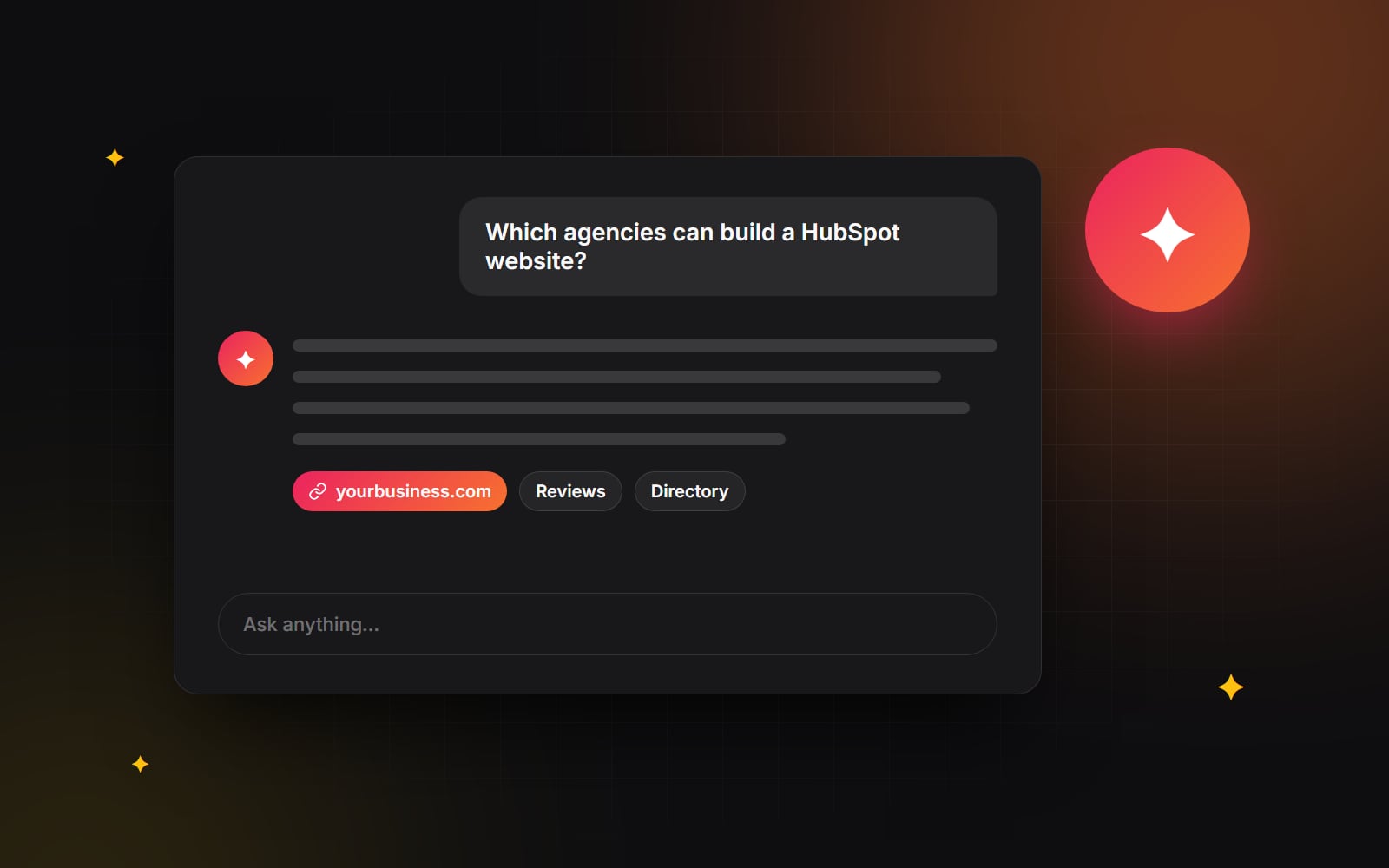
A growing number of people skip the search results and ask an AI assistant instead: "Which agencies build HubSpot websites?", "What's a good accountant near me?", "Is Shopify or WooCommerce better for a small shop?" The assistant answers in a paragraph, often naming a few businesses and linking to its sources.
Naturally, every business wants to be one of the names. There's no shortage of advice promising a shortcut. The honest answer is less exciting but more useful: what gets you mentioned is mostly what has always made a business easy to find and easy to trust online. This guide explains how AI assistants find information and what you can actually influence.
How AI assistants find businesses
Assistants draw on two kinds of information:
- What the model learned in training. Large language models are trained on a huge amount of public text up to a cut-off date. If your business was widely and consistently described online before then, the model may already "know" about you.
- What it looks up live. Tools such as ChatGPT search, Perplexity, Microsoft Copilot and Google's AI Overviews search the web as they answer and cite the pages they used. Here, your current website and the pages that mention you matter most.
The second kind is where you have the most influence, and it works much like traditional search. Google says the same practices that help pages appear in Search also apply to its AI features, with no special markup required.
1. Let the right crawlers in
AI companies use named crawlers, and your robots.txt file decides which ones may visit. Several companies separate crawlers that gather training data from those that fetch pages for live answers, so you can make different choices for each:
- OpenAI: OAI-SearchBot for ChatGPT's search results, GPTBot for training.
- Anthropic: Claude-SearchBot and Claude-User for search and user requests, ClaudeBot for training.
- Perplexity: PerplexityBot.
- Google: AI Overviews use Google's normal search crawler. The separate Google-Extended setting controls whether your content is used for Gemini, not whether you appear in Search.
If your robots.txt blocks these, or your hosting firewall does, assistants can't read your pages when they answer. Check with whoever manages your website, and make a deliberate choice rather than an accidental one.
2. Say clearly what you do
Assistants summarise. If your website is vague, the summary will be too. Make sure your pages state plainly:
- What you do, for whom, and where.
- The specific services or products you offer, each with its own page.
- Facts people ask about: platforms you work with, areas you cover, how a project works, typical timelines.
Write pages that answer a question in the first paragraph, then explain in more detail. Assistants tend to quote pages that give a direct answer, and visitors appreciate it too.
3. Be described consistently everywhere
Assistants build a picture of your business from many sources, and they're more confident when those sources agree. Use the same business name, description and contact details on:
- Your website, including structured data that describes your organisation and links to your official profiles.
- Your Google Business Profile.
- Your LinkedIn company page and other social profiles.
- Industry directories and partner listings relevant to your field, such as platform partner directories or review sites in your sector.
4. Be mentioned by others
When assistants recommend businesses, they often cite review sites, directories, comparison articles and industry publications rather than the businesses' own websites. Being present and well reviewed on the sources your customers trust is one of the most reliable ways to be included. Ask satisfied clients for reviews on those platforms, contribute expert articles or quotes to industry publications, and keep directory listings complete and current.
5. Help search engines find your pages quickly
- 1 Verify your site in Google Search Console and submit your sitemap.
- 2 Do the same in Bing Webmaster Tools. Bing's index powers Microsoft Copilot and is used by other services too, and it's often overlooked.
- 3 Consider IndexNow, a protocol supported by Bing and other search engines that notifies them as soon as you publish or update a page.
- 4 Make sure your pages load quickly and work without heavy scripts, so crawlers can read the content. Our guide to Core Web Vitals covers speed.
What doesn't help
- Hidden text or pages written only for AI. Assistants and search engines see through content that visitors can't, and it can count against you.
- Publishing large volumes of thin, generated articles. Lots of near-identical pages make a site look less trustworthy, not more.
- Buying fake reviews or mentions. It breaks the rules of most review platforms and, in many countries, consumer protection law.
- Chasing every new trick. Advice in this area changes quickly. Work that makes your business genuinely clearer and better reviewed doesn't go out of date.
How to tell if it's working
- Ask the assistants yourself once a month. Use the questions your customers would ask, note whether you're mentioned, and note which sources they cite. If they keep citing a directory you're not listed in, that's your next step.
- Check referrals in analytics. Visits from assistants often appear as referrals from sites such as chatgpt.com or perplexity.ai. Our guide to GA4 reports shows where to look.
Be wary of anyone who guarantees placement in AI answers. Nobody controls what these tools say, and answers change from one day to the next.
The short version
Be easy to read, be clear about what you do, be described the same way everywhere, and be mentioned by sources people trust. It's the same work that helps you in search, and it keeps paying off whichever tools people use next.
We help businesses with the website side of this: clear page structure, structured data and fast, crawlable pages, as part of our web development work. If you're curious how AI could help inside your business too, read about AI chatbots for websites or our AI automation services, and get in touch.
Planning something similar?
Tell us what you're building and we'll come back with ideas and next steps.