How to write a website brief that gets you accurate quotes.
Vague briefs get vague, inflated quotes. Here's what to include so agencies can quote accurately and you can compare proposals like for like.
Few things create more frustration for business owners than reaching out to three digital agencies for a website redesign quote and receiving proposals that range from $5,000 to $65,000. It feels like the Wild West. How can three reputable studios looking at the exact same requirement come back with numbers that differ by a factor of ten?
From the briefs we receive, one thing is clear: vague briefs produce wildly unpredictable quotes. When an agency receives a one-page document stating "We want a modern, clean, mobile-friendly website that converts well and integrates with our CRM," they have to make dozens of invisible assumptions.
One agency assumes you want an off-the-shelf WordPress template with five pages and quotes $5,000. Another agency assumes you require a bespoke design system, custom interactive 3D components, multi-language localization, and complex HubSpot workflow integrations, quoting $65,000.
If you want accurate, fixed-scope proposals that allow you to compare agencies apples-to-apples, you need a structured website brief. Here is the exact framework and list of questions we recommend every client include before requesting proposals.
1. Define the commercial problem, not just the visual symptoms
Most briefs spend three paragraphs explaining that their current website "looks outdated." While visual fatigue is a real feeling, aesthetic dissatisfaction is rarely why a business invests tens of thousands of dollars in a rebuild.
Tell the agency what commercial metric is broken:
- Conversion breakdown: "We generate 15,000 monthly organic visitors to our product pages, but our lead form conversion rate has dropped from 2.8% to 0.7% over the last 18 months."
- Brand misalignment: "We recently raised a Series A funding round and are moving upmarket from $50/mo self-serve customers to $25,000 enterprise accounts. Our current cartoonish branding makes enterprise security leads distrust our product."
- Operational paralysis: "Our marketing team currently takes two weeks and requires an external developer just to launch a simple landing page or update customer testimonials."
When an agency understands the actual commercial bottleneck, their proposal will focus on strategic business outcomes rather than just pushing pixels around.
2. Inventory your scope and content architecture
Don't leave the size of the project up to imagination. Be specific about the structural scope of the website:
Map out page templates, not just page counts
Saying "Our site has 40 pages" doesn't tell a developer much. Building 40 completely unique layouts takes far longer — and costs far more — than a modular system of six reusable templates that produce the same 40 pages.
List your distinct page templates:
- Homepage and Brand Story overview
- Core Solutions / Service landing page template
- Individual Case Study / Customer Story template
- Editorial / Blog Hub and Individual Article template
- Pricing Matrix or Product Specification table
- Contact and Interactive Booking funnel
Clarify who produces the content
In our experience, the most common cause of website delays is content that isn't ready. Be crystal clear in your brief: will your internal team provide finalized, proofread copywriting, high-res photography, and video assets? Or do you need the agency to handle full-funnel copywriting, messaging frameworks, and custom 3D asset creation?
3. Detail your required third-party integrations and tech stack
A website rarely exists in isolation. It is the front-door interface to your entire sales, marketing, and operational stack. An agency needs to know what software sits behind your form fields:
- 1 CRM and Marketing Automation: Do you use HubSpot, Salesforce, ActiveCampaign, or Mailchimp? Do you need custom deal stage routing or lead enrichment? (For ideas, see five automations every website should have.)
- 2 Payments and Commerce: Are you processing payments via Stripe, Shopify Checkout, or custom invoicing portals? If you haven't chosen a platform yet, here's how we'd decide.
- 3 Hiring and Recruitment: Do you host careers listings via Greenhouse, Lever, Workable, or Ashby?
- 4 Analytics and Compliance: Do you have specific enterprise compliance requirements, such as GDPR cookie consent banners, HIPAA compliance, or WCAG 2.2 AA accessibility requirements?
4. State your budget range and target launch deadline honestly
Many businesses hide their budget because they fear the agency will simply quote whatever number they state. But keeping your budget secret actually wastes your own time.
If your hard budget cap is $15,000, and you send a brief to an enterprise agency whose minimum project engagement starts at $50,000, both teams waste two weeks scheduling discovery calls and writing RFP responses for a project that was never economically viable. Stating a realistic budget bracket (e.g., "We have allocated between $18,000 and $25,000 for this initiative") allows smart agencies to tailor an optimal scope that maximizes your return on investment within your real constraints.
Similarly, be honest about deadlines. If you have an immovable deadline — such as an upcoming industry keynote, an autumn product launch, or an investor demo day — state it immediately so the agency can evaluate their current production capacity.
A great design agency isn't just looking for a project — they are looking for a partner. A clear, thoughtful brief proves you respect their expertise and sets the stage for a collaborative build.
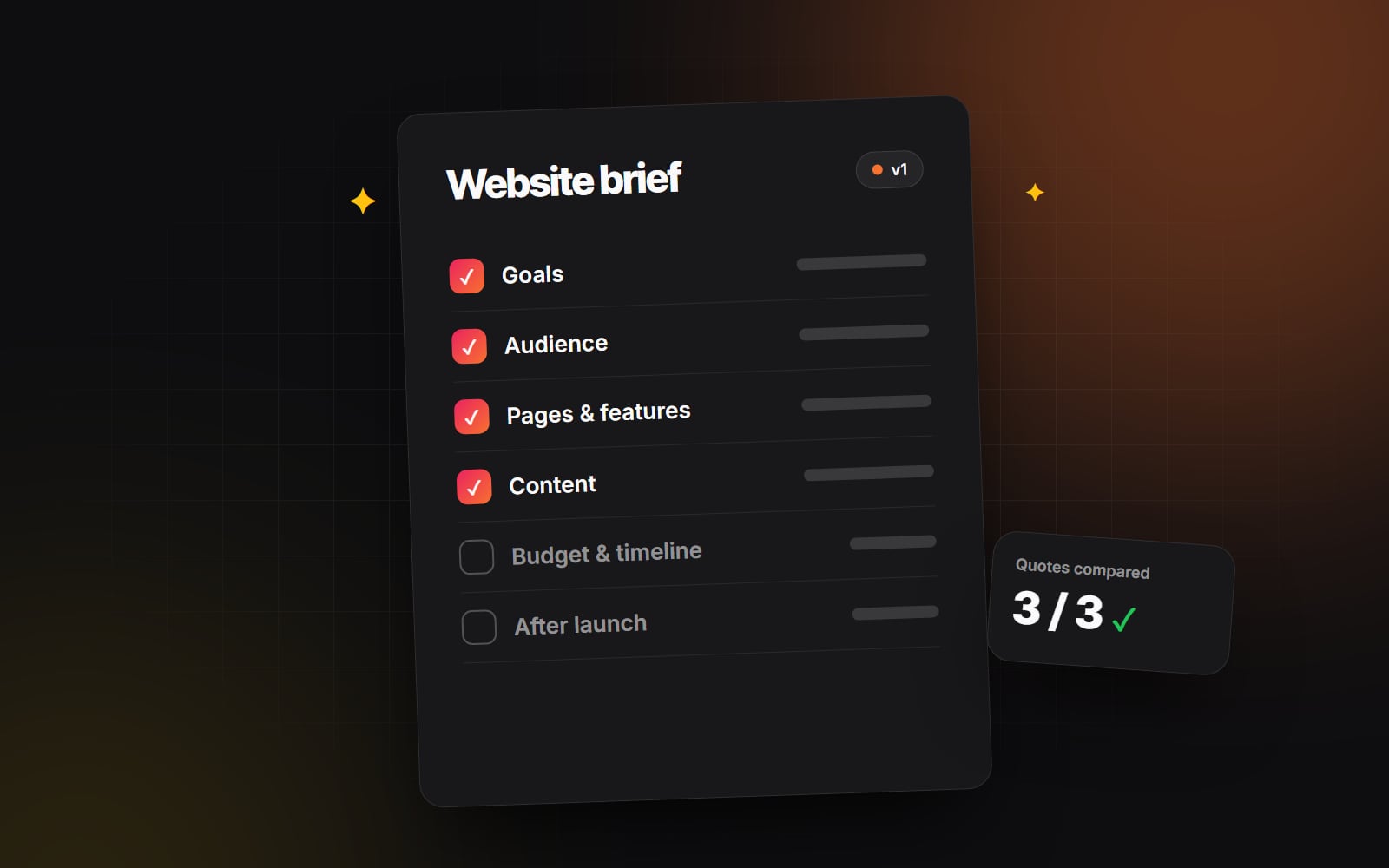
The checklist summary: what to send your agency shortlist
Before hitting send on your outreach emails, ensure your brief covers these essential sections:
- Executive summary: Who you are, what you sell, and your core audience.
- The business challenge: Current conversion bottlenecks and why the redesign is happening now.
- Scope of deliverables: Estimated page templates, CMS requirements, and mobile responsiveness needs.
- Content and asset ownership: Who handles copy, photography, illustration, and brand guidelines.
- Technical integrations: CRM, analytics, billing, and third-party APIs.
- Timeline and budget bracket: Realistic target launch date and approved financial range.
At Web Canvas, a person reads every brief, and we reply with a clear, itemized proposal with no hidden costs. Share yours with our team and we'll tell you what's possible.
Planning something similar?
Tell us what you're building and we'll come back with ideas and next steps.