HubSpot developer, freelancer or agency: how to decide.
Freelancer, in-house HubSpot developer or agency? What each suits, how team size and support needs affect the choice, and how to plan handover.
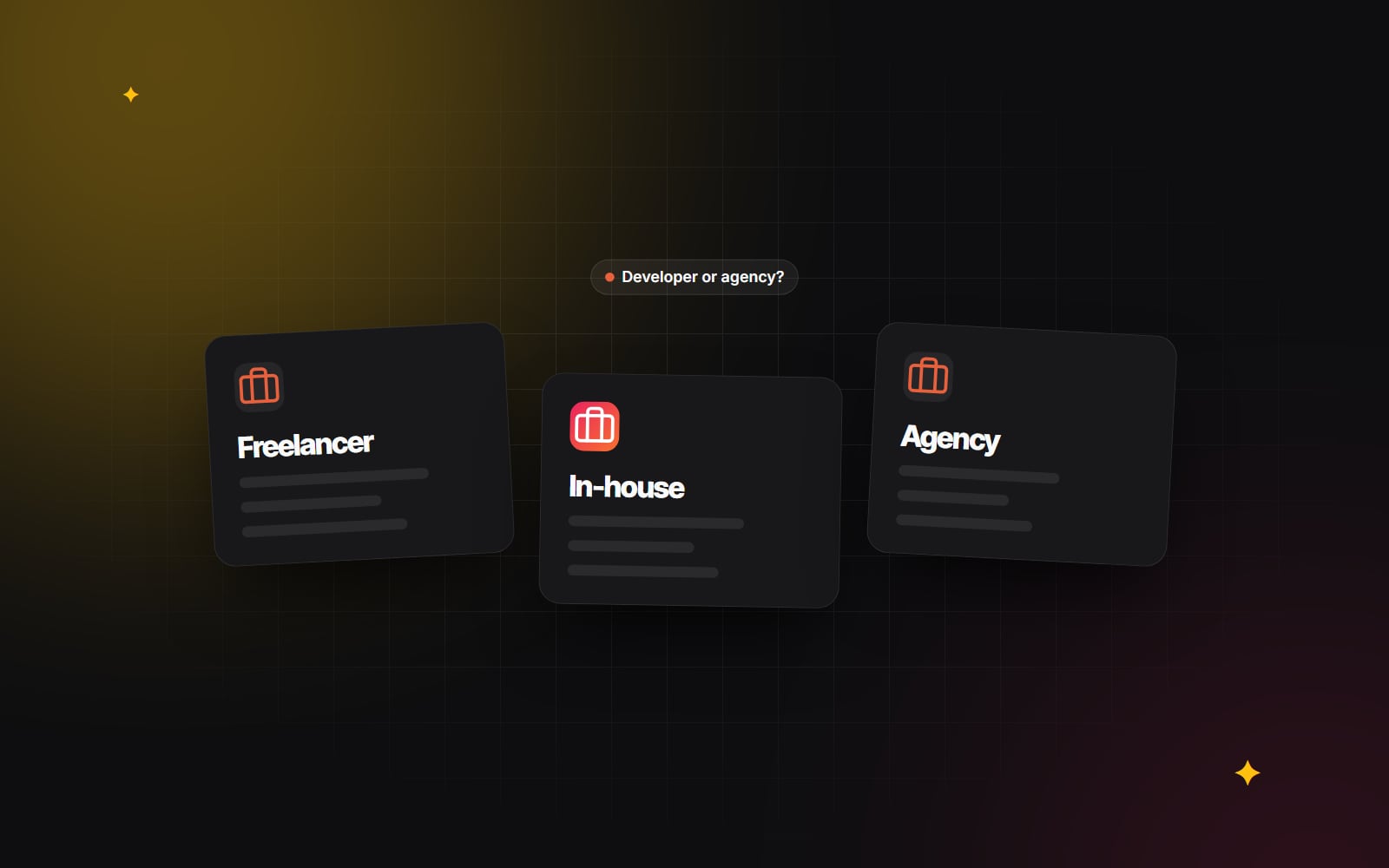
If you run your website on HubSpot, sooner or later you need a HubSpot developer. The next question is what kind: a freelancer, someone on your own team, or an agency. None of these is the right answer for everyone. Each has strengths and trade-offs, and the right choice depends on the work in front of you rather than on which option sounds safest.
The three options in plain terms
Freelance HubSpot developer
One person, usually working with several clients, paid per project or per block of time. A good freelancer brings focused HubSpot development skills and direct communication: you talk to the person writing the code. The limits are capacity and cover. When they are on holiday or busy with another client, your work waits.
In-house HubSpot developer
Someone on your payroll, or on a long-term contract, who works only on your systems. They learn your CRM data, your sales process and your brand in depth. The trade-off is that one person rarely covers design, front-end, CRM architecture and API work equally well, and you take on the usual responsibilities of an employer. If there is not enough HubSpot work to fill their week, they will end up on other tasks.
Agency
A team that can combine design, HubSpot development, content and CRM set-up. Agencies are set up to run projects with several moving parts and to cover for absence. The trade-off is that you may talk to a project manager more than to the developer, and processes such as change requests can feel heavier for small tasks.
Comparison at a glance
| Factor | Freelancer | In-house | Agency |
|---|---|---|---|
| Best for | Defined tasks, single modules, fixes | Frequent, ongoing changes | Full builds, redesigns, mixed-skill projects |
| Range of skills | Depends on the individual | Depends on the individual | Usually broader across a team |
| Knowledge of your business | Grows over time | Deepest | Grows over time; may be spread across people |
| Cover for absence | Limited | Limited | Usually built in |
| Communication | Direct with the developer | Direct, same organisation | Often through a project or account lead |
| Process overhead | Light | Light | Heavier, more structured |
| Main risk | Knowledge sits with one person | Not enough work, or skill gaps | Paying for process on small tasks |
Match the option to the work
Look at what you actually need over the next year, not just the next project.
- A new theme or full redesign usually needs UX, visual design, HubL development, content migration, redirects and training. That mix favours an agency, or a freelancer who works closely with a designer you already trust.
- A handful of new modules or landing page templates is well suited to a freelancer, provided your existing theme is in good shape.
- Weekly page builds, campaign pages and small fixes may justify an in-house HubSpot developer or a marketer trained in the page editor, with outside help for larger jobs.
- CRM integrations with an ERP, e-commerce platform or internal database need someone comfortable with private apps, APIs and webhooks. Ask specifically about this, whichever option you choose.
- Ongoing support works best with a written arrangement covering response expectations, what is included and how extra work is approved. Our website maintenance retainer checklist lists what to include.
Team size and who maintains the site
Small marketing teams often do better with a well-built theme and a light support arrangement than with a full-time developer. If the theme gives editors flexible modules and sensible theme settings, most day-to-day page work does not need code at all.
Larger teams with several regions, languages or business units tend to need more governance: shared module libraries, naming rules, approval steps and someone who owns the theme. That person can be in-house, with an agency or freelancer supporting bigger releases.
Handover: the part people forget
Whichever route you take, plan for the day the person or team who built the site is no longer available. A clean handover protects you from being locked in.
- The theme lives in a Git repository your organisation controls, not only in the HubSpot Design Manager.
- Every module has clear field labels and short notes on how it should be used.
- Private app tokens, API keys and integration accounts are created under your company's accounts, not personal ones.
- Your domain, DNS and HubSpot portal are owned by your business. Our guide on who owns your website's domain explains how to check.
- User access for outside developers is removed or reduced when the engagement ends.
Ownership of code and design files, and the terms of any contract, are matters to agree in writing. Take professional advice on the contract itself, especially if the developer or agency is in another country, because rules on employment status, tax and intellectual property differ by location.
Questions to help you decide
- 1 How much HubSpot work do we expect each month, roughly: occasional, steady or constant?
- 2 Does the work need design, content or CRM skills as well as development?
- 3 Who will edit pages day to day, and how comfortable are they in the HubSpot editor?
- 4 What happens if our developer is unavailable during a launch?
- 5 Do we need integrations with other systems, now or soon?
- 6 Who on our side will review work and approve changes?
- 7 How will knowledge be documented so we are not dependent on one person?
Mixed models work too
Many businesses combine options. An agency builds the theme and module library, an in-house marketer runs the editor, and a freelancer or the same agency handles occasional development on a support arrangement. What matters is that responsibilities are clear: who owns the theme, who approves changes, and who is called when something breaks.
How to compare proposals fairly
Freelancers, in-house hires and agencies are hard to compare on cost alone, because they include different things. A freelance quote may exclude design and project management. An agency proposal may include discovery, QA and training that a freelancer would treat as extras. Give everyone the same brief and ask them to list what is and is not included. Our guide on how to compare website quotes covers this in more detail.
Checklist: choosing your HubSpot development partner
- 1 Write down the HubSpot work you expect over the next year.
- 2 Mark each item as design, development, CRM or integration work.
- 3 Decide who will maintain the site and edit pages after launch.
- 4 Choose the option, or mix of options, that covers those skills.
- 5 Send the same brief to each candidate and ask for a list of inclusions.
- 6 Ask each candidate how they hand over code, documentation and access.
- 7 Confirm that your company owns the domain, portal, repository and app credentials.
- 8 Agree support terms in writing and take professional advice on the contract.
Web Canvas is an agency that works on HubSpot themes, CRM set-up and integrations, and offers HubSpot support alongside our broader web development service. If you are weighing up options and want a second opinion on the scope, get in touch.
Planning something similar?
Tell us what you're building and we'll come back with ideas and next steps.