How to compare website quotes when the prices are miles apart.
Three agencies, three very different prices. How to make website quotes comparable, the questions to ask, and the red flags to watch for.
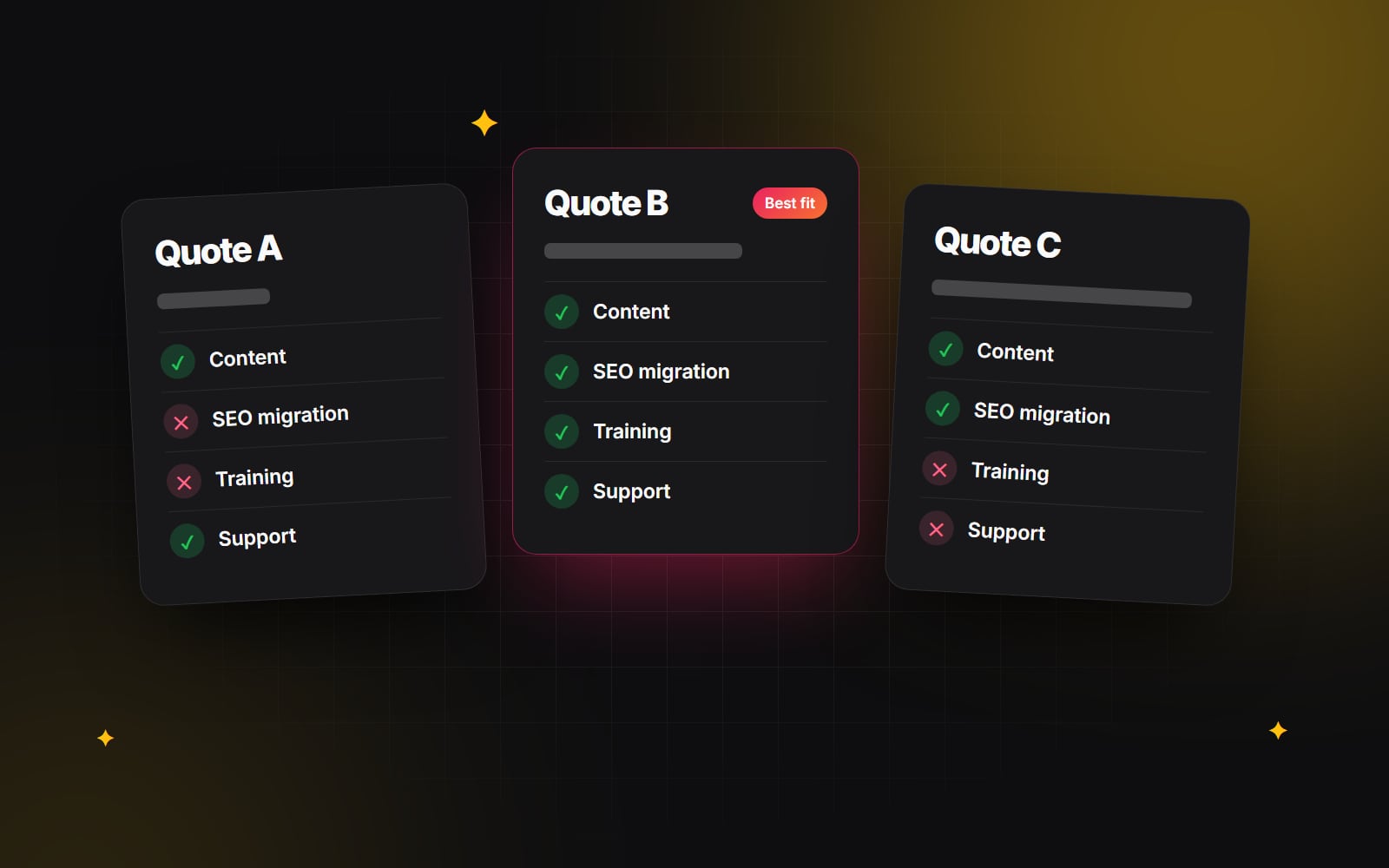
You've sent your project to three agencies and the quotes have come back. One is a few hundred, one is a few thousand, and one is several times that. They all say "website", and it's hard to tell what the difference actually is.
Wide gaps are normal, and they rarely mean one supplier is honest and the others aren't. Usually each one has assumed a different project. This guide shows how to make quotes comparable, the questions that reveal what's really included, and the warning signs to look out for. We're an agency ourselves, so this is also the checklist we'd want you to use on us.
Why website quotes vary so much
The price of a website depends on decisions that a short brief often leaves open. Each supplier fills the gaps differently:
- Template or custom design. Adapting a ready-made theme is quicker than designing every page around your brand and your customers.
- Who writes the content. Some quotes assume you'll supply every word and image; others include copywriting, photography or both.
- Platform and features. A five-page site on a website builder is a different job from a Shopify store with custom product filters or a site connected to your CRM.
- What happens to your current site. Moving existing pages, keeping search rankings with redirects and migrating data all take time, and they're easy to leave out.
- Testing, training and support. Testing on real devices, teaching your team to edit the site and fixing issues after launch are often where cheaper quotes save money.
Step one: give everyone the same brief
Quotes are only comparable if every supplier is pricing the same project. Before you compare prices, make sure each one received the same information: your goals, the pages you need, the features, who provides content, and your timeline. Our guide to writing a website brief that gets accurate quotes includes a template you can use.
Then ask each supplier for a breakdown by line item rather than a single total. It makes the next step much easier.
Questions that reveal what's included
Go through each quote with these questions. Where an answer isn't in writing, ask for it.
- 1 How many page designs are included? Ask how many unique layouts will be designed, how many pages will be built from them, and how many rounds of changes are allowed.
- 2 Who writes and loads the content? If you're supplying it, find out the deadline and whether loading it into the site is included.
- 3 How will it work on phones? Every supplier will say "responsive". Ask how they design and test for mobile. Our article on mobile-first design explains what good looks like.
- 4 Is accessibility included? Ask which standard they work to. The current version is WCAG 2.2, and our accessibility basics explain why it matters.
- 5 What happens to my search rankings? If you have an existing site, ask whether redirects from old URLs to new ones are included. Our redesign SEO checklist lists what should happen.
- 6 How fast will it be? Ask whether they test page speed before launch, for example against Google's Core Web Vitals.
- 7 Will my team be trained? Find out how you'll edit pages, add blog posts or update products after launch.
- 8 What are the running costs? Hosting, platform subscriptions, paid plugins or apps, and any maintenance plan. A cheaper build on a platform with higher monthly fees can cost more over three years.
- 9 What's covered after launch? Ask how long bugs are fixed free of charge, and what support costs after that.
- 10 Who owns what? Ask who will own the domain, the hosting account, the design files and the code once you've paid. Get the answer in the contract, and if anything is unclear, have it checked by your own legal adviser before you sign.
Red flags
- No questions before the quote. A supplier who prices a project without asking anything is guessing.
- Vague promises. "SEO included" or "fully optimised" means little unless it says what will actually be done.
- Your domain or accounts in their name. Everything should be registered to your business. Our guide to checking who owns your domain explains why.
- No testing or staging site. You should be able to review the website before it goes live.
- Pressure to sign quickly, or large payments up front with no milestones.
- No examples of similar work. Ask to see live websites, not only screenshots, and if possible speak to a past client.
Score the quotes, not only the prices
Once you've filled the gaps, put the quotes side by side and score each one, for example out of five, on what matters most to you. A simple list works well:
- How well they understood your goals and customers
- Quality of their previous work, ideally in your sector
- What's included, using the questions above
- Total cost over three years, not only the build price
- Communication: how clearly and quickly they answered
Often the cheapest quote turns out to leave out work you'll pay for later, and the most expensive one includes things you don't need. Asking each supplier to price the same scope usually closes much of the gap.
Have a conversation before you decide
A quote is a document; a project is months of working together. Before you choose, book a short call with your top two suppliers and pay attention to how it goes:
- Do they ask about your business, your customers and what success looks like, or only about pages and features?
- Do they push back where something in your brief won't help you? A good supplier will tell you when a feature isn't worth the money.
- Do you understand their answers? If they can't explain their process without jargon now, it won't get easier during the project.
- Who will you actually work with? Ask whether the people on the call are the people doing the work.
It's also fair to ask what they'd do differently if the budget were smaller. The answer shows which parts of the quote they think really matter, and it gives you a sensible fallback if you need to phase the work.
Talk to us
We're happy to be one of the quotes you compare. You can see the kind of work we do in case studies such as Design Executive Council and SaaSFlow, and read how we work. If you'd like to talk through a project, or get a second opinion on a quote you already have, get in touch.
Planning something similar?
Tell us what you're building and we'll come back with ideas and next steps.