Local SEO for professional firms: profiles, pages and reviews.
Marketing guidance for accountants, consultants, clinics and law firms on Google Business Profile, consistent listings, local pages and genuine reviews.
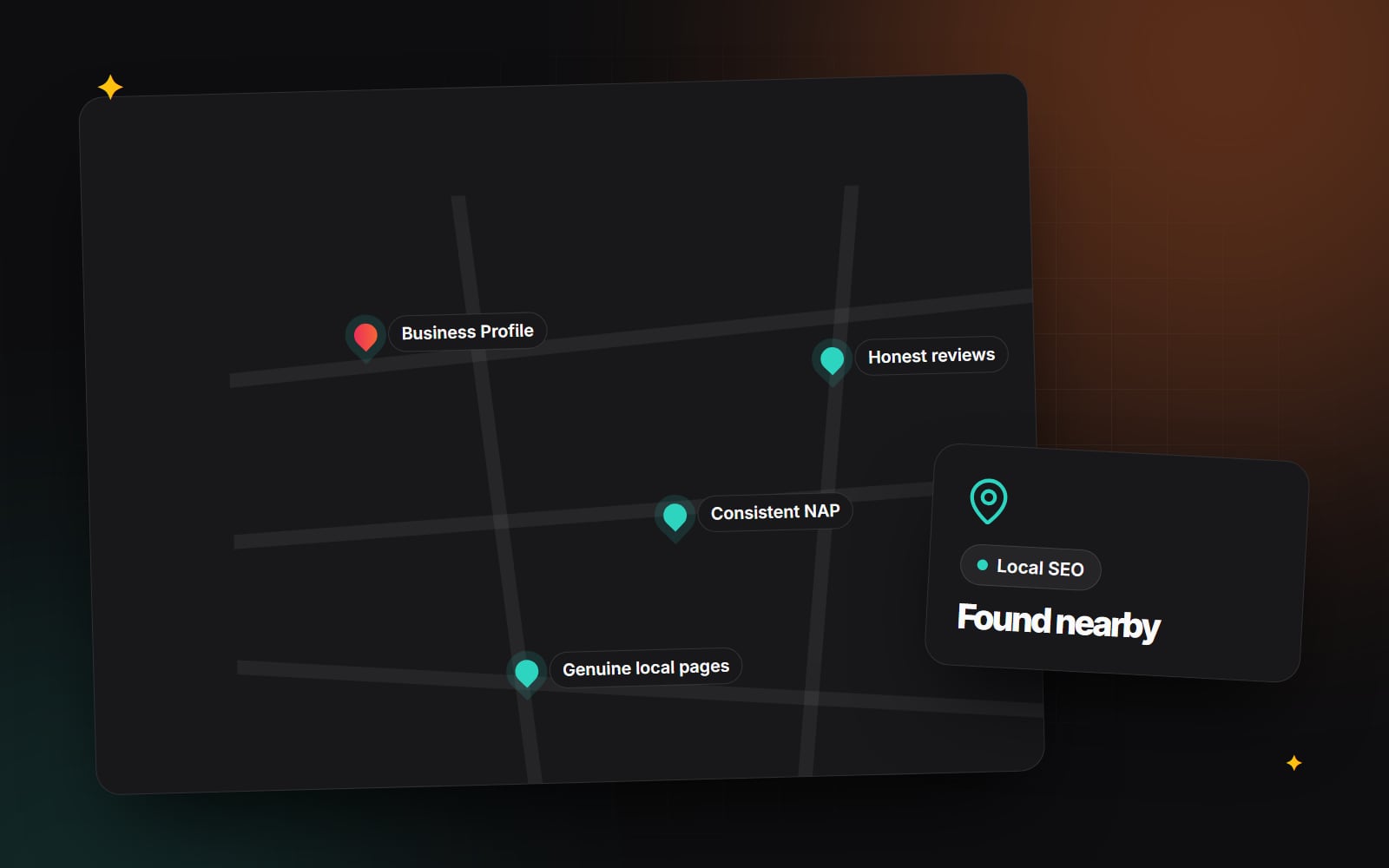
For many professional firms, such as accountants, architects, consultants, clinics and law practices, some of the most valuable enquiries start with a local search. Someone looks for "accountant near me" or "architect in Bengaluru", sees a map with a few businesses on it, and contacts one of them. These searchers usually have a specific need and are close to making a decision.
Local SEO is the work that helps your firm appear in those results. It isn't a one-off task of claiming a Google Business Profile. It combines an accurate profile, consistent business details across the web, useful pages on your own site and a steady flow of genuine reviews.
How Google decides local rankings
Google's own explanation of how local ranking works names three main factors:
- Relevance: how well your profile matches what the person searched for.
- Distance: how far your business is from the searcher or the location in their query.
- Prominence: how well known your business is, based on information from across the web, including reviews, links and articles.
You can't change distance, but you can influence relevance and prominence. The rest of this guide focuses on those.
1. Get your Google Business Profile right
Your profile is often the first thing a local searcher sees. Our Google Business Profile checklist covers set-up in detail. The essentials:
- 1 Use your real business name exactly as it appears on your signage and stationery. Don't add keywords or locations to it; Google's guidelines for representing your business prohibit this and it can lead to suspension.
- 2 Choose the primary category that best describes your main service, then add secondary categories only for services you genuinely provide.
- 3 Add your services with short, accurate descriptions.
- 4 Set your opening hours, including holiday hours, and keep them up to date.
- 5 If you visit clients rather than receiving them at an office, set a service area and hide your address, as the guidelines require.
- 6 Add real photos of your office, team at work (with their permission) and premises.
- 7 Post updates when you have something worth sharing, such as a new service or office move.
2. Keep your business details consistent
Your name, address and phone number (often shortened to NAP) should match everywhere they appear: your website, Google Business Profile, Apple Maps, Bing Places, LinkedIn, professional directories and local business listings.
Inconsistencies such as an old phone number, a previous address or a different version of your firm's name can confuse both search engines and potential clients. To check:
- 1 Write down your exact preferred name, address format and main phone number.
- 2 Search for your firm's name and your phone number to find listings you may have forgotten.
- 3 Update or claim each listing so the details match.
- 4 Keep a simple spreadsheet of where you are listed, so you can update everything if you move.
Focus on directories that are genuinely relevant to your profession or region. A handful of accurate, relevant listings is more useful than a large number of low-quality ones.
3. Build useful local pages on your website
If you have offices in several towns, or genuinely serve clients in distinct areas, a page for each location can help. Each page needs to be useful in its own right:
- The office address, phone number, opening hours and directions, where you have a physical office.
- The people who work there or serve that area, and the services actually offered locally.
- Information that is specific to that area, such as parking, accessibility or local requirements your clients ask about.
Don't create pages for areas you don't serve, or near-identical pages with only the town name changed. Google treats these as doorway pages under its spam policies. Our guide to programmatic SEO explains where the line is.
On each genuine location page, LocalBusiness structured data (or a more specific type such as AccountingService or LegalService) can describe the address, hours and contact details. It must match what is visible on the page. Our schema markup guide covers how to add it.
The rest of the site matters too. Clear service pages, fast loading and an easy way to get in touch all help visitors who arrive from local search take the next step. This is the kind of work our web development team handles.
4. Ask for reviews the right way
Reviews influence prominence and, more importantly, help prospective clients choose. A steady flow of recent, genuine reviews is more useful than a burst once a year. Check your professional body's rules first, then:
- 1 Get your review link from your Google Business Profile, using the Ask for reviews option.
- 2 Decide on a natural point to ask, such as when a piece of work is completed.
- 3 Send the request to all clients at that stage, not only to those you expect to be happy. Asking only satisfied clients (review gating) goes against Google's policies.
- 4 Keep the message short and neutral. You can ask clients to mention what you helped with, but don't tell them what to write.
- 5 Never offer discounts, gifts or other incentives for reviews, and never post reviews on behalf of clients or staff.
- 6 Reply to reviews politely and in your own words. Don't include confidential client details in replies; in many professions, even confirming someone is a client may be a problem.
Respond to negative reviews calmly and offer to continue the conversation privately. A measured reply often reassures future readers more than the review itself worries them.
5. Earn local prominence
Prominence grows from being genuinely known in your area and field. Practical ways to build it:
- Speak at or support local business events and professional associations.
- Write useful guides that answer questions your clients actually ask, such as how a process works or what documents to prepare.
- Contribute expert comment to local or trade publications.
- Publish case studies or project write-ups where clients have agreed to it and your professional rules allow it.
Clear, well-structured information about who you are and what you do also helps as search moves towards AI-generated summaries; our guide to getting mentioned in AI answers covers this.
What to avoid
- Adding keywords or locations to your business name on Google.
- Buying, swapping or writing fake reviews.
- Creating listings at addresses where you don't operate, such as virtual offices.
- Publishing near-duplicate pages for every nearby town.
- Making claims your professional rules don't allow, such as "best" or "specialist" where those terms are restricted.
Local SEO rewards being accurate, consistent and genuinely useful over time. If you would like help with your website's local pages, structure or content, get in touch.
Planning something similar?
Tell us what you're building and we'll come back with ideas and next steps.